


How Uzbekistan’s Modern Trade Market Is Shaped: An Overview of the Largest Retail Chains in 2026
Modern Trade in Uzbekistan continues to expand at a rapid pace. While traditional markets and independent neighborhood stores have historically dominated the retail landscape, supermarket chains, minimarkets, discount retailers and specialized retail formats are now playing an increasingly important role.
The expansion of nationwide retail networks, new store formats, loyalty programs and digital shopping services is making Modern Trade one of the key drivers of the country’s FMCG market.
According to Balton Trading Asia’s market analysis, Uzbekistan’s organized retail sector is becoming increasingly concentrated around several major players that are shaping the future of Modern Trade.
The Three Largest Chains Dominate Modern Trade
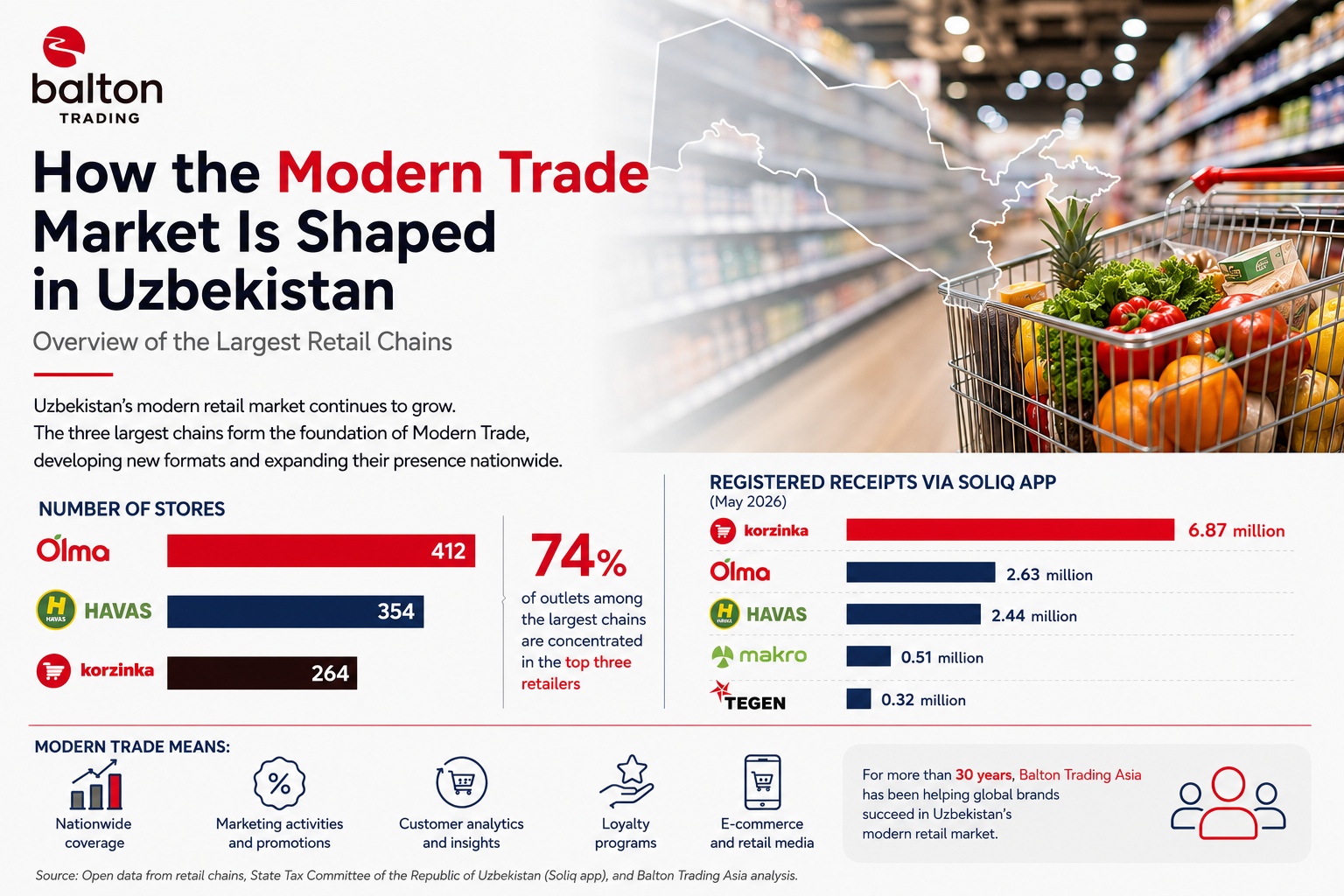
Measured by the number of stores, the market is led by Olma, Havas and Korzinka. Together, these three retailers operate more than one thousand stores and account for approximately 74% of all outlets among the country’s largest Modern Trade chains.
However, the number of stores alone does not fully reflect market leadership.
Store Count Does Not Equal Market Leadership
The success of a retail chain depends on far more than physical expansion. Customer traffic, average basket size, assortment strategy, store format, digital services and loyalty programs all contribute to a retailer’s market position.
This is clearly illustrated by data published by Uzbekistan’s State Tax Committee on purchase receipts registered through the Soliq mobile application.
As of May 2026, Korzinka significantly outperformed other retail chains in the number of registered purchase receipts, while Olma and Havas, despite operating larger store networks, ranked second and third respectively.
This demonstrates that retail performance is driven not only by scale but also by customer engagement, operational efficiency and shopping experience.
Different Strategies for a Growing Market
Each leading retailer is pursuing its own growth strategy.
Olma focuses on extensive neighborhood coverage through a large network of convenience stores.
Havas continues expanding its discount format, targeting frequent everyday purchases.
Korzinka strengthens its position in the modern supermarket segment by emphasizing product assortment, customer service, digital innovation and loyalty programs.
Meanwhile, Makro, Assorti, Baraka, Daily (Fix Price) and Tegen continue expanding their presence across different regions of Uzbekistan.
The specialized retail segment is also growing rapidly. M Cosmetics, with more than one hundred stores, demonstrates the increasing importance of the beauty and drugstore category.
Modern Trade Is Becoming the Main Growth Engine for FMCG
The rapid development of organized retail is transforming how manufacturers and distributors build brands.
Modern retail chains now provide centralized purchasing, nationwide product launches, sales analytics, promotional platforms and retail media opportunities that were previously unavailable through traditional trade.
As Modern Trade continues to grow, brands increasingly require tailored strategies for each retail format, from supermarkets and discount stores to e-commerce and specialized retail.
Balton Trading Asia: More Than 30 Years of Retail Expertise
For more than 30 years, Balton Trading Asia has been helping international brands grow in Uzbekistan by partnering with the country’s leading retail chains.
With nationwide distribution, deep market expertise and extensive experience across all Modern Trade formats, the company supports manufacturers in building sustainable growth, expanding market presence and reaching consumers throughout Uzbekistan.
Understanding the evolving retail landscape remains one of the key success factors for brands entering and developing in Uzbekistan’s FMCG market.
_________________________________________________
Methodology: This analysis was prepared by Balton Trading Asia based on publicly available information from retail chains, data published by the Tax Committee of the Republic of Uzbekistan, and the company’s own industry expertise. Store-count figures reflect the scale of each retailer’s physical presence and should not be interpreted as an estimate of its share of total retail sales or market turnover.