


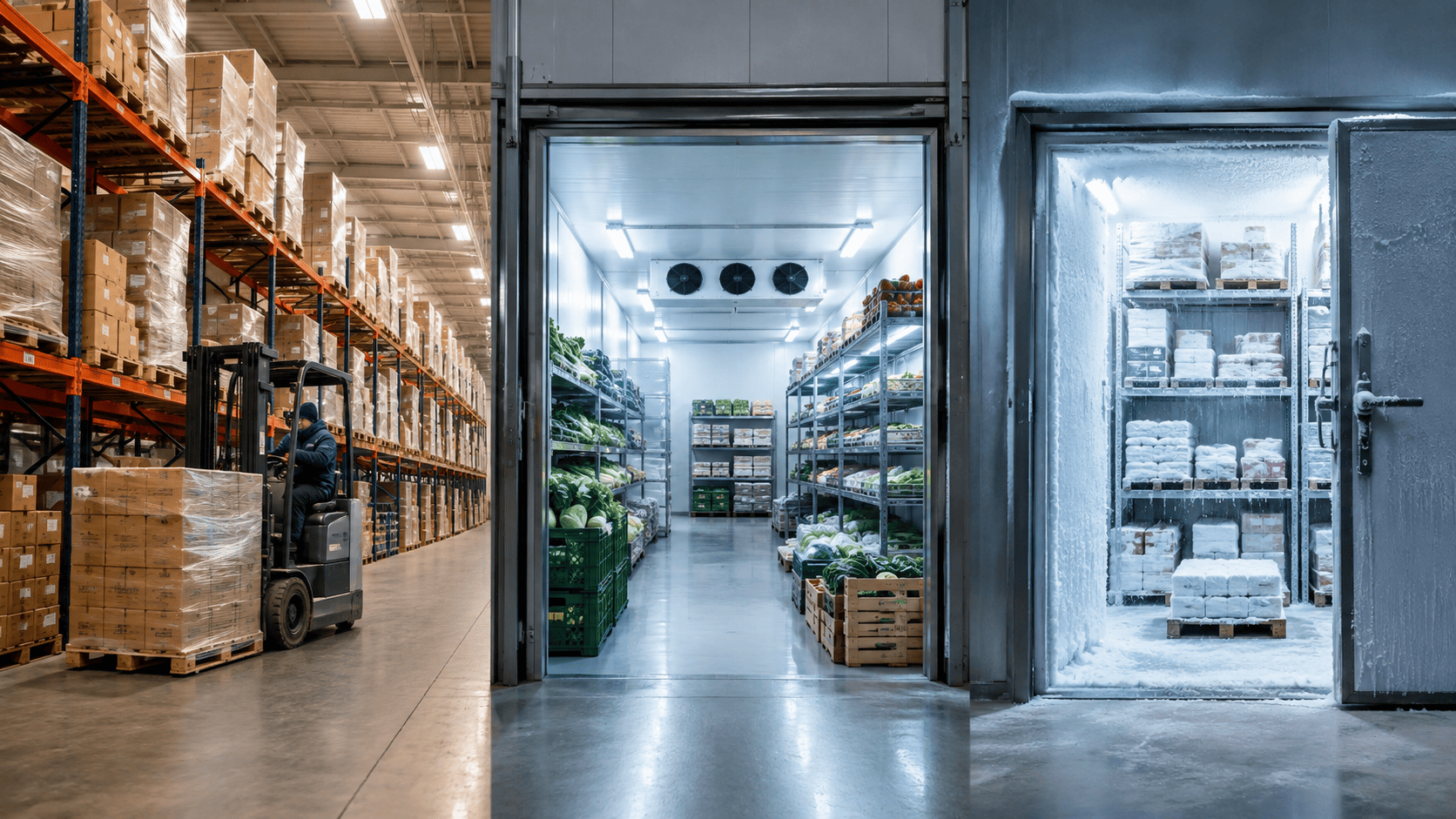
Three temperature modes — one quality standard
Maintaining the correct temperature regime helps preserve product quality, safety, and shelf life. The required temperature must be maintained not only during storage but also throughout loading and transportation.
Three temperature regimes for storage
Products are stored in separate zones according to the manufacturer’s requirements:
- Ambient storage — for groceries, beverages, canned goods, snacks, and other products that do not require refrigeration. Temperature, humidity, ventilation, and proper product segregation are controlled in these areas.
- Chilled storage — for products that must be kept at reduced positive temperatures. Even a short-term deviation from the required temperature may reduce a product’s shelf life.
- Frozen storage — for products requiring a stable sub-zero temperature, generally no higher than −18°C, unless otherwise specified by the manufacturer. It is important to prevent thawing and subsequent refreezing during storage.
The specific storage temperature is always determined by the product labelling and the manufacturer’s requirements.
Key storage requirements
Each temperature regime requires a dedicated and properly equipped storage area. This helps maintain stable conditions, ensure appropriate product segregation, and prevent cross-contamination.
Warehouse operations should include:
- continuous temperature monitoring and recording;
- control of shelf life and dispatch sequence;
- traceability of product batches;
- compliance with sanitary requirements;
- minimising the time products spend outside their designated temperature-controlled zones.
For products with a limited shelf life, the FEFO principle is applied: products with the earliest expiry dates are dispatched first.
Maintaining an uninterrupted cold chain
Temperature control does not end when products leave the warehouse. Chilled and frozen goods must also be transported under appropriate temperature conditions.
Balton Trading Asia uses refrigerated vehicles that maintain the required temperature throughout the delivery route. Storage and transportation therefore form a continuous cold chain — from receipt of the goods to their delivery to the retail outlet.
Balton Trading Asia capabilities
Balton Trading Asia has the infrastructure required for all three temperature regimes: ambient, chilled, and frozen storage.
The company’s refrigerated warehouse facilities are certified under the international FSSC 22000 scheme. This demonstrates a systematic approach to food safety management, process control, and product traceability.
Dedicated storage zones, continuous temperature monitoring, and refrigerated transport help preserve product quality throughout the entire journey to the retail outlet.